1. Setting
Let \(\Phi:\mathbb{R}_{\ge0}\to[\varphi_{\min},\varphi_{\max}]\) with \(0<\varphi_{\min}\le\varphi_{\max}<\infty\), and let \(\varphi\) be absolutely continuous with \(\varphi(0)=0\) and
Physical time is \(t=\varphi(\tau)\). Write \(\tau_T:=\varphi^{-1}(T)\).
2. Nature of the Computational Problem
The three failures below share one mechanism, which we name unverified schema retrieval: a retrieved template is applied without evaluating the predicate that determines its domain of validity, so the conclusion is emitted from surface-feature similarity rather than from hypothesis satisfaction.
In each case the governing predicate is short, decisive, and carries almost no lexical weight. Retrieval is computed over co-occurrence rather than logical structure, so the features placing a passage near a stored template are precisely those that do not determine whether the template applies. No stage of the pipeline evaluates the predicate: the schema arrives with its conclusion attached, and the conclusion is reported.
3. First: The Weight is \(\varphi'\), Not \(\varphi'^{-1}\)
From \(t=\varphi(\tau)\) one has \(dt=\varphi'(\tau)\,d\tau\), hence for measurable \(f\ge0\)
The weight is \(\varphi'\). The reciprocal \(\varphi'^{-1}\) occurs elsewhere and correctly: the lifted momentum equation carries \(\varphi'(\tau)^{-1}\partial_\tau U\), since \(\partial_t u=\varphi'^{-1}\partial_\tau U\); and the inverse substitution gives \(d\tau=dt/\varphi'\). Neither is (2). Reproducing \(\varphi'^{-1}\) in (2) completes a nearby pattern instead of differentiating \(t=\varphi(\tau)\).
Unevaluated predicate: which of \(t\) and \(\tau\) is the variable of integration.
4. Second: Displacement Requires Degeneracy
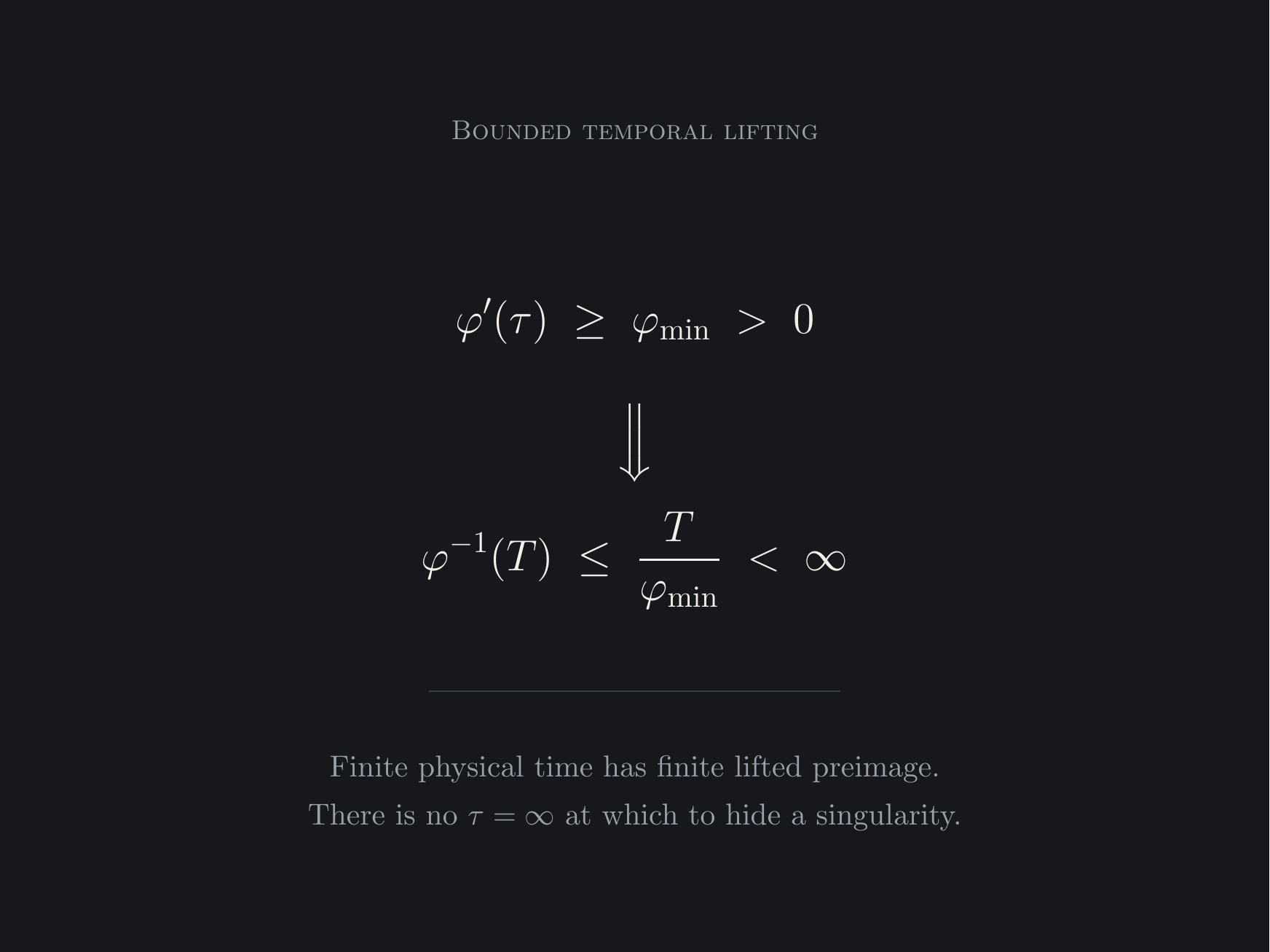
Lemma 4.1. Under (1), \(\varphi(\tau)\ge\varphi_{\min}\tau\), and for every \(T<\infty\)
\[ \varphi^{-1}(T)\;\le\;\frac{T}{\varphi_{\min}}\;<\;\infty. \tag{3} \]Proof. \(\varphi(\tau)=\int_0^\tau\varphi'\ge\varphi_{\min}\tau\). Put \(\tau_T=\varphi^{-1}(T)\); then \(T\ge\varphi_{\min}\tau_T\). ∎
Lemma 4.2. Let \(\varphi\) be absolutely continuous, \(\varphi(0)=0\), \(\varphi'\ge0\) a.e. If \(\varphi(\tau)\uparrow T^*<\infty\) as \(\tau\to\infty\), then \(\varphi'\in L^1(0,\infty)\) and \(\operatorname*{ess\,lim\,inf}_{\tau\to\infty}\varphi'(\tau)=0\).
Proof. Monotone convergence gives \(\int_0^\infty\varphi'=T^*<\infty\). Were \(\operatorname*{ess\,lim\,inf}\varphi'=c>0\), some \(\tau_0\) would satisfy \(\varphi'\ge c/2\) a.e. on \((\tau_0,\infty)\), forcing \(\int_0^\infty\varphi'=\infty\). ∎
Displacement of a singularity to \(\tau=\infty\) presupposes exactly the hypothesis of Lemma 4.2, which (1) excludes. Sundman's density \(dt/ds=r_{12}r_{13}r_{23}\) vanishes on the collision set and is degenerate; \(\Phi\) has range bounded below by \(\varphi_{\min}>0\) and is not. By (3), no finite physical time has infinite lifted preimage.
The two constructions are separated by one inequality. Transferring a conclusion from the first to the second is a transfer across the hypothesis that distinguishes them.
Unevaluated predicate: \(\operatorname*{ess\,lim\,inf}_{\tau\to\infty}\varphi'(\tau)=0\).
5. Third: The Bound is Proved Once, and Transported Once
The uniform vorticity bound is established in physical time: for \(u^\circ\in H^{s}_{\mathrm{div}}(\mathbb{T}^3)\), \(s>5/2\), and every \(T>0\),
with \(C\) independent of \(N\). Since \(t=\varphi_N(\tau)\) with \(\varphi_N'\in[\varphi_{\min},\varphi_{\max}]\), (4) transports to \(\|\Omega_N(\tau)\|_{L^\infty}\le C\) on \([0,\tau_T]\), and \(\tau_T<\infty\) by (3). Applying (2) with \(f=\|\omega\|_{L^\infty}\),
Beale–Kato–Majda is then applied in physical time, to the physical equation, on the physical integral.
Treating (4) as though it were established on \([0,\tau_T]\) and the physical bound derived from it produces an apparent circle \(t\to\tau\to t\). No such circle occurs: the bound is proved once, in physical time, and transported once.
Unevaluated predicate: the coordinate in which (4) is stated.
6. Closing
Each correction is a line of calculus, and in each case the predicate that settles it is stated in the source. The failure is not that the predicate is hard to evaluate but that it is never evaluated: a reciprocal correct in a neighbouring equation, a mechanism whose hypothesis was not checked, a bound whose coordinate was not tracked.
This yields a test. Asking a system to verify an equation against the document containing it does not exercise the missing step, since agreement with in-context text is the cheaper completion. Withholding the document and requiring the derivation does.